A driveway is one of the few jobs on a house where nearly everything you pay for ends up buried. The surface is the only part you see, and it is also the cheapest thing on the quote to get right. That is why choosing the firm matters more than choosing the colour. In Havering there are three facts worth knowing before anyone measures your front: only the council or its approved contractors may build a dropped kerb, and applying costs £261 before construction is even priced; a contract you agree at your own front door normally comes with 14 days to change your mind; and paying part of the bill by credit card can bring the card company into it under Section 75 for anything from £100 to £30,000. None of that tells you who is good. It does tell you which firms are not, and this guide is about using the site visit, the quote, the kerb, the paperwork and the payment plan to tell the two apart.
What a good site visit looks like on a Hornchurch front
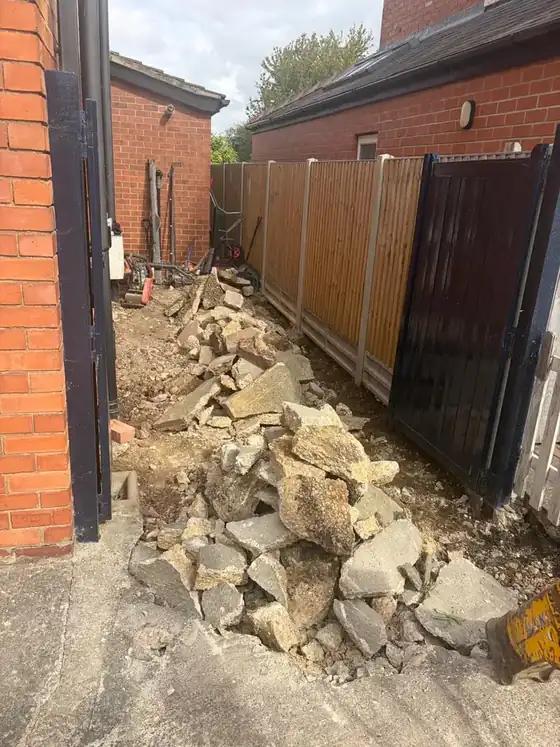
The visit is where most of the sorting happens, and you learn a lot by keeping quiet and watching what the estimator does. Someone who knows this area will not stand at the gate and give you a price. They will want to see what is under the existing surface, because on an interwar semi that is often a patchwork: a 1970s concrete slab, a strip of crazy paving along the side passage, a soakaway nobody remembers, and broken brick where a front wall once stood. The photo below is from one of our own jobs, and that pile of old concrete came out of a passage that looked perfectly sound from above.
Then there is the ground. Roughly speaking, the south of the patch (Elm Park, South Hornchurch, the lower end of Upminster) sits on river terrace gravel, and the land rising north towards Emerson Park, Ardleigh Green and Cranham is London Clay. A firm that has worked here will ask which end you are at or tell you before you say. One that quotes the same dig depth for a house off Wingletye Lane as for one near Elm Park station either has not thought about it or is pricing the cheap version and hoping.
Watch for the practical questions too. How will spoil leave the site if the only route to the back is a passage 900 mm wide? Where do your downpipes empty now? Is the existing crossover wide enough for the parking you want? Whether you end up with block paving, resin or tarmac, those answers shape the job more than the brochure does, and an estimator who asks none of them in twenty minutes is telling you how the job will go.
Putting three quotes side by side
Get three, and get them in writing. The cheapest is not automatically wrong and neither is the dearest; the point is that three written quotes show you where the money actually goes. If two firms specify 200 mm of compacted stone on a membrane and the third says “prepare ground”, you have found the reason the third one is £1,200 lower.

A proper quote names the things you will never see again once the surface is on. That means the depth of the dig and of the sub-base, the material it is built from, what holds the edges (concrete-bedded kerbs, a block soldier course, or nothing), and how the surface water is dealt with. On a front garden that last point is not optional. Since 2008 an impermeable drive over five square metres that drains onto the road needs planning permission, so the quote should say whether the surface is permeable, whether it falls to a border, or whether a channel and soakaway are included. Sustainable drainage, or SuDS, is just the formal name for making sure the rain soaks away on your own land rather than running into the gutter, and on the clay half of Hornchurch that takes design rather than optimism.
We have written a line-by-line guide to what belongs on a quote in our cost guide for Hornchurch and Upminster driveways, so we will not go through it all again here. For choosing a firm, the useful test is simpler: could you hand this quote to a different contractor and have them build exactly the same drive? If not, it is a price, not a specification.
Who builds the kerb, and why it is a good test
This is the most local check in the whole guide, and it catches more firms than anything else. In Havering the pavement belongs to the council. Its dropped kerb application page is clear that the crossover is built by the council or a contractor it has approved, after you have paid the £261 fee and accepted the inspection quote. A crossover built by anybody else is liable to be ripped out, and you get the bill.
So ask every firm how they handle the kerb. The right answer sounds something like: you apply to the council, they build the crossover, and we set the drive levels so it meets their new kerb cleanly and falls away from the house. A firm that says “we will drop it for you, saves all the council hassle” is either willing to do something unlawful on your behalf or does not know the borough well enough to realise. Neither is someone you want digging up your front garden.
It matters more than usual here because so many 1930s fronts in Hornchurch and Upminster were given a single-width crossover decades ago, when one small car was the most anyone expected. If you want two cars side by side you may need it widened, and that is the council’s job and the council’s timetable. A contractor who raises this at the first visit, unprompted, has done this before. If your house is on one of the busier roads such as Hall Lane, Butts Green Road or Corbets Tey Road, a new access may need planning permission too, which our post on driveway planning permission in Havering covers in detail.
Doorstep offers and the “leftover tarmac” pitch
You may have had the knock already. A pleasant man in a hi-vis says his crew has just finished a job round the corner, there is tarmac left in the lorry, and he can do your drive this afternoon for cash at a price that sounds too good, because it is. Variations include a “free” survey that finds your existing drive is about to collapse, or a price that was per square yard on the doorstep and somehow per square metre on the invoice.

Think about what “this afternoon” actually means. A proper tarmac drive starts with digging out, laying and compacting a sub-base, and fixing an edge restraint before any hot material arrives. None of that fits in an afternoon with whatever is left in a lorry. What you get instead is a thin skin of tarmac rolled over your old surface or over loose soil, with no edge to stop it spreading. It looks black and tidy for a few months, then cracks along every line in the slab beneath and crumbles where it meets the lawn.
Council Trading Standards teams up and down the country give the same advice: do not agree work on a cold call, do not pay cash up front, and get a name and a full postal address rather than a mobile number. If you have already said yes at your own door, the law is on your side. Under the Consumer Contracts Regulations 2013 a contract agreed at your home normally gives you 14 days to cancel. The trader has to give you that information in writing, and if they do not, the cancellation period can run on for up to a year. Failing to give it on a contract agreed at home is a criminal offence in its own right.
Checking the firm is who it says it is
Most of this takes ten minutes at a laptop. If the business is a limited company, look it up on Companies House and check that the name and number on the quote match a live company, how long it has existed and whether its accounts are up to date. A company that was formed six weeks ago, or one with a string of dissolved predecessors run by the same directors, is worth a second thought.

If the quote adds VAT, it should show a VAT number, and HMRC lets you put that number into the check a UK VAT number service to see the business name and address it belongs to. A trader who adds VAT without being registered is simply pocketing 20 percent of your bill.
Then ask for the public liability insurance certificate, not just a line saying “fully insured”. Look at the name on it, which should be the business you are contracting with, and at the expiry date. A driveway job involves a mini digger next to your house, your neighbour’s car and quite possibly a gas pipe, so this matters. While you are at it, ask who will actually be on site. Plenty of good firms use a regular subcontracted crew, which is fine, but you should know who they are and that the firm whose name is on the quote is responsible for them.
Guarantees and payment stages
A guarantee is only as good as the business giving it and the words it is written in. Ask to see the wording before you sign, not after. It should say what is covered (sinking, rutting and loose edges caused by the groundwork, not just the surface colour), for how long, and what you have to do to keep it valid. Ask too what happens if the company stops trading. Some firms back their guarantee with an insurance policy that survives them; many do not, and a ten-year promise from a business that lasts three years is a three-year promise.

Money is where you have the most control, so use it. A front drive on a semi is typically three to five days on site. There is no good reason for a firm to need most of the price before it starts, and “materials up front in cash” is a phrase that should end the conversation. A reasonable pattern is a small deposit or none, perhaps a stage payment once the sub-base is in and you have seen its depth with your own eyes, and the balance when the job is finished and you have walked it together. If you can pay part of it by credit card, Section 75 of the Consumer Credit Act makes the card provider jointly liable for a breach of contract on purchases between £100 and £30,000, which is a useful safety net on a job of this size.
Take photos of the dig before the surface goes on. Ask the crew to leave the tape measure in shot. If the quote said 200 mm and the hole is clearly 100 mm, that is the moment to raise it, not two winters later.
Look at their old work, not their new photos
Every firm’s gallery is full of drives on the day they were finished, when everything looks crisp. What you want to see is a drive they laid four or five years ago. Ask for two or three addresses nearby, in Hornchurch, Upminster or the streets around them, and go and look from the pavement. Ignore the colour. Look at whether the edges are still straight, whether there is a dip where the car sits, whether water pools by the gate and whether weeds have found the joints.
A local firm that has been working here for a while should be able to point you to jobs on roads you know. If every reference is somewhere forty miles away, or the only reviews are on a site you have never heard of, ask why. And if the neighbours of a past job are out, it is worth asking them how the work went. People are usually happy to tell you whether the crew turned up on time and cleared up after themselves.
The contractor worth hiring is the one who digs to the depth they quoted, leaves the kerb to the council, puts the drainage in writing and does not want your money before they have earned it. If you would like us to be one of your three quotes, book a free site visit in Hornchurch or Upminster and we will go through every one of these points with you on your own front.