Two firms can measure the same 45 square metre front in Hornchurch and come back with £3,600 and £5,400 for a resin driveway, and neither has to be lying. That £1,800 is almost always one question: is the resin going on top of what you already have, or is everything coming out first? Our rate for resin bound is £80 to £120 per square metre, and the bottom and top of that band are two different jobs. Once that’s clear, the rest of a resin driveway cost in Hornchurch and Upminster is easier to follow. The ground decides a lot. So do the house you live in, the edge, the drain and a council kerb that never appears on our invoice.
Resin driveway cost in Hornchurch: overlay at £80, dig-out at £120
At £80 a square metre you are paying for an overlay. The old tarmac or concrete stays where it is. We clean it, repair any small defects, prime it and trowel 15 to 18mm of resin bound stone straight on top. That only works if the old surface is thick, level, free of cracks and not moving. Resin has almost no strength of its own, so any crack below shows through it within a winter or two.
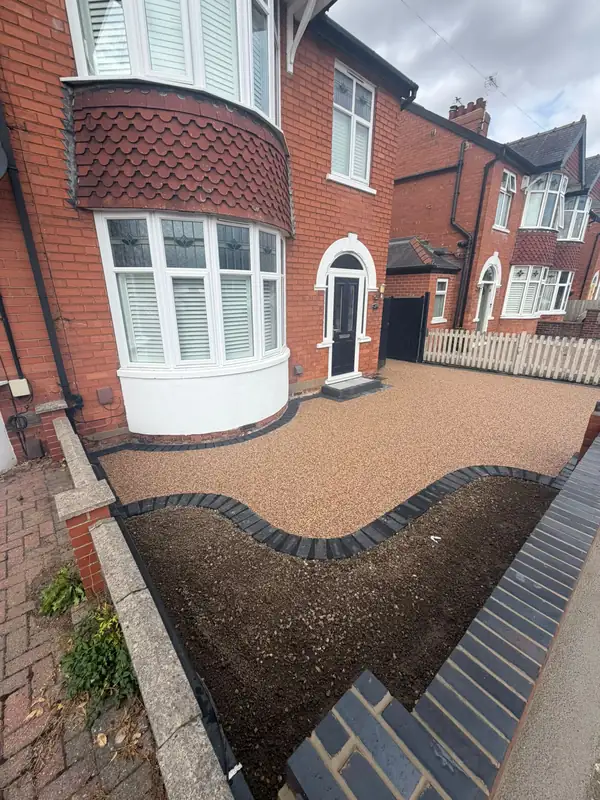
At £120 a square metre the old drive comes up and goes in a skip. We dig out, put a geotextile membrane on the subsoil, compact MOT Type 1 stone in two layers, set new edging in concrete, roll an open-graded tarmac binder over the whole area and lay the resin on that. You’re paying for a new drive, built from the soil up.
Most people ask us for the overlay. Most of the drives we look at can’t take one, because a 1970s slab that looks fine from the doorstep often turns out to be cracked right through when we dig a test hole beside it. Our resin driveways page shows the full build-up we use, and the quote you get from us says which of the two jobs yours is and why.
Resin driveway prices for three Havering fronts
Square metres matter more than anything else on the quote, so here are the three fronts we measure most often, worked through at our band.
A 1930s semi in Hornchurch or Elm Park
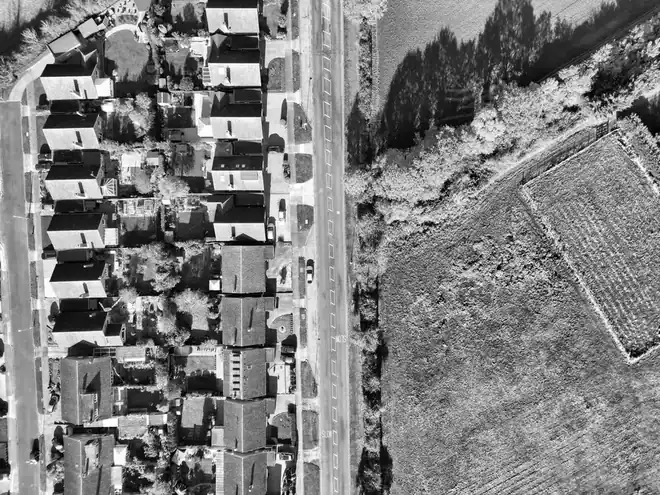
Knock the front wall down to the pillars, take out the lawn and you have about 45 square metres for two cars. That comes to £3,600 to £5,400. A semi that already has a sound concrete hardstanding sits near the bottom of the band. One where crazy paving and turf both have to come out sits near the top.
A bungalow in Cranham
The roads of bungalows south of Cranham’s shopping parade tend to have shorter, squarer fronts, often one car and a path to the door. Call it 30 square metres, or £2,400 to £3,600. Small drives drift towards the top of the band because the skip, the mixer and the crew on pour day cost the same whatever the size.
A detached house in Emerson Park
Plots between Butts Green Road and Wingletye Lane often run to 80 or 120 square metres with a turning circle. A 100 square metre sweep comes out at £8,000 to £12,000. The rate per metre stays the same, but curves, steps and long edges add hours.
If you’re still weighing up materials, we’ve priced block paving on the same fronts and put every surface side by side.
Resin bound or resin bonded: the cheaper quote is a different drive
Some cheap “resin” quotes aren’t for resin bound at all. Resin bonded is a thin coat of resin rolled onto a base with loose stone scattered into it. It’s quicker to lay and the finish is rough. It isn’t porous, and it keeps shedding stone onto the pavement long after the first week.
The porosity point costs real money. Since October 2008, covering more than five square metres of front garden with a surface that doesn’t let water through needs planning permission, unless the run-off goes to a lawn or border on your own plot. If you want the detail, the rule and its exceptions are in the government’s front garden permeable surfacing guidance. Resin bound lets rain soak through, so a properly built one needs no application. Bonded does not, so either you add drainage to make it legal or you take the risk. We don’t lay bonded on drives. If a quote says “resin” and nothing more, ask which kind.
What London clay adds under a resin drive
Havering is split by the railway. South of it, round Elm Park and south Upminster, the subsoil is Thames terrace gravel. It drains and it compacts well. North of it, towards Emerson Park, Harold Wood and Cranham, you are on London Clay, which holds water and changes volume between a wet February and a dry August.
On clay the dig goes to about 200mm. The membrane stops the stone working down into the clay, and the Type 1 goes down in two compacted layers so it can’t settle later. Above that, the open-graded binder gives the resin a rigid, porous layer to grip. Each of those steps is labour, plant and material that a drive on gravel may need less of, and that’s the main reason clay-side jobs land closer to £120 than £80.
It also changes how the drive lasts. If a clay-side resin drive has gone wrong, the crack nearly always follows a weak spot in the base. Fixing it later costs more than building it right the first time. Our post on driveway repair costs explains why patching resin rarely matches.
Edging and drainage: the lines that hold the price together
Resin is trowelled against a fixed edge, and that edge keeps the drive from spreading. A plain concrete kerb is the cheapest. A block or brick soldier course costs more and looks better against interwar brick. Aluminium trim suits a crisp modern line. Whichever you choose, it has to be bedded and haunched in concrete before any binder goes down. A plastic strip pinned to the soil is what fails first.

Resin bound drains through itself, but the water still has to go somewhere once it reaches the base. On gravel ground it soaks away without fuss. On clay it can sit in the stone, so we fit a linear channel across the gateway and sometimes extra drainage further in. That’s the SuDS idea in practice: keep rain on your own plot instead of sending it down the road gully. A drive with a big fall towards the house, or a plot that floods in heavy rain, adds a day of groundwork. Our London clay drainage guide covers the options in more depth.
The dropped kerb is Havering’s bill, not ours
A new resin front is no use if you can’t drive onto it. If there’s no crossover yet, that’s a separate job with a separate bill. Havering Council’s dropped kerb page sets out the process. There’s a non-refundable £261 application fee, then an inspection and a quote for building it. Only the council or its approved contractors can build it, and the council removes any it finds built by anyone else.

Some roads also need planning permission for the kerb, and the council keeps a list of Havering roads that need planning permission for a dropped kerb. Hall Lane, St Marys Lane, Corbets Tey Road and Butts Green Road are among them. Put the application in before we book the drive. Then the gateway can be shaped to fit the kerb, and you won’t have a finished drive you can’t park on. Our dropped kerb guide goes through the timing.
What else moves a resin driveway cost up or down
Once the ground and the overlay question are settled, smaller things decide where in the band you land.
What’s coming up matters first. Turf lifts in a morning. A reinforced concrete slab, or crazy paving bedded in mortar, fills more skips and can add a day or two of breaking out.
Then shape. A rectangle is quick to edge, while a curved sweep with a planting island in the middle has far more edging for every square metre of resin. Paths to the side gate, a step up to the porch or a contrasting border can all go down in the same pour, and that’s cheaper than bringing the mixer back next year.
Access counts too. The skip and the mixer need to park close, and on a narrow road with no room outside everything takes longer to barrow in. We only use UV-stable resin, so that isn’t a line you can trim, and we wouldn’t want you to: the cheaper aromatic kind turns a buff drive yellow within a few summers.
And check your street. Gidea Park is covered by an Article 4 direction, so even a permeable front drive there needs permission. That doesn’t add anything to our price, but it does add weeks.
The fastest way to find out which side of £100 a square metre your front falls on is a site visit with a trial hole. We’ll measure up, look at what’s under the surface and give you a written price with the dig depth, base, edge and resin product on it. Book a free resin driveway quote in Hornchurch or Upminster.