Upminster, RM14

Patios In Collier Row

Is the back of your Collier Row semi still a cracked concrete path and a soggy lawn?

Porcelain, Indian sandstone, limestone and concrete slab patios built on clay-ready bases behind the 1930s houses of Collier Row

Most patios in Collier Row sit behind the same house: a 1930s semi with a bay at the front, a side passage, and a decent garden running back over London Clay. That clay is the whole story. It swells in a wet winter, shrinks in a dry August, and drags a thin bed of sand and slabs along with it. We lay patios in Collier Row from our Upminster yard, on the streets off Collier Row Lane, up around Chase Cross and Havering Park, and down through Mawneys towards Romford. Every one goes on 100 to 150 mm of compacted MOT Type 1 with a geotextile underneath, falls away from the house at 1 in 80 or better, and gets jointed with a two-part resin compound. Prices start at £90 per square metre laid.

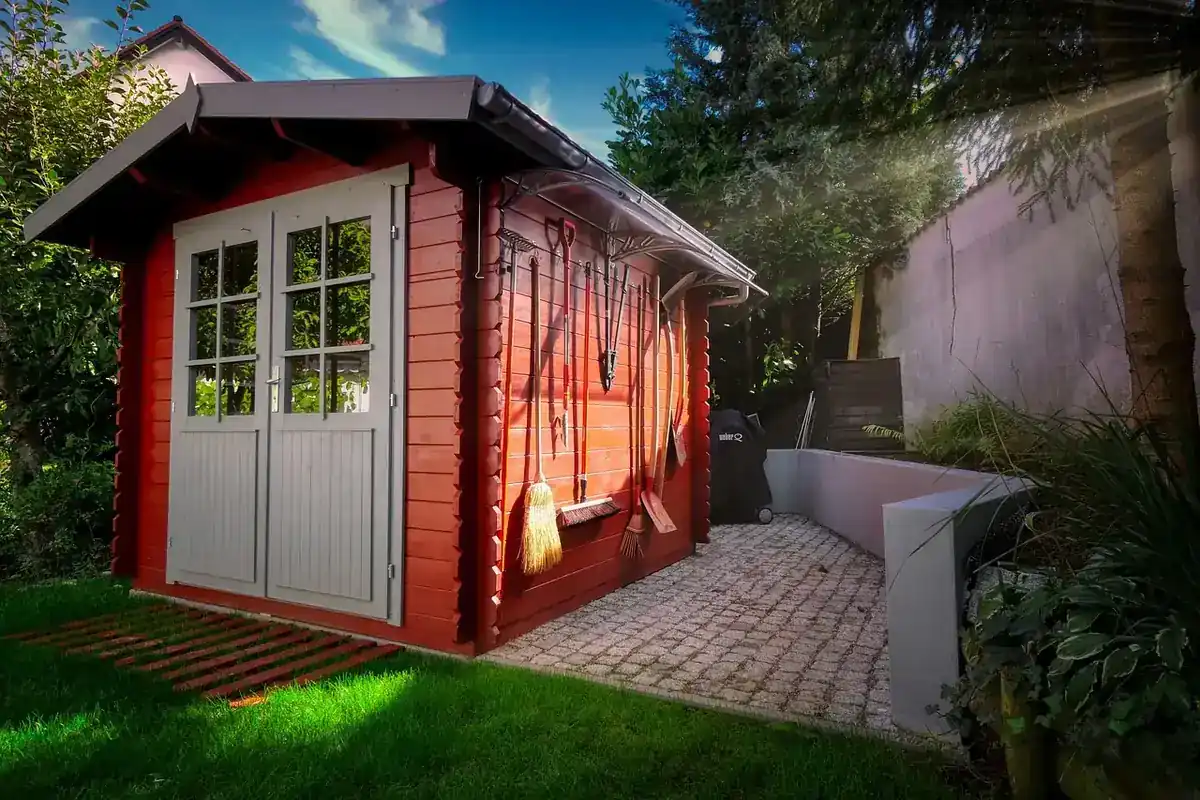
Back garden with a small paved area beside a painted timber shed, a rendered wall and a lawn
No obligation

Free Patios Quote In Collier Row

We reply the same working day, usually within the hour.

Or ring 01708 209015. Your details stay with us.

The family behind the firm

Collier Row patios from across Romford

Collier Row sits on the far side of Romford from our Upminster yard, which still counts as local for Jim and his family. They have spent 35 years laying driveways and patios and choose to stay within a short drive of home.

That choice keeps our costs down, so a Collier Row patio is priced leanly. Most new customers come because a neighbour or friend mentioned us.

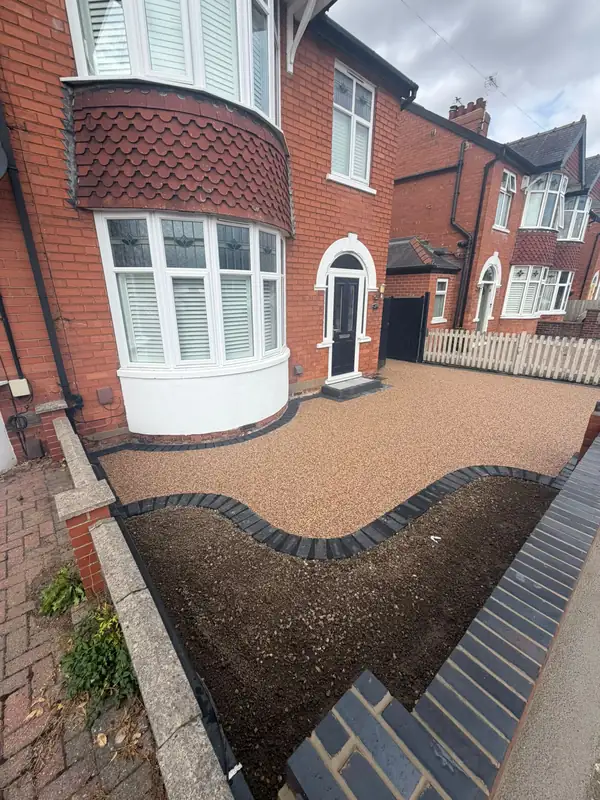
Buff resin bound front garden with curved dark block edging around a new soil bed outside a red brick bay-fronted house
Buff resin front with curved block edging
Patios in Collier Row

What a properly built patio gets you on Collier Row clay

01

Slabs that stay level

A geotextile between the clay and the stone stops the base being pushed down into the subsoil. That is the difference between a terrace that is still flat years from now and one with a dip by the back door.

02

Water kept off the back wall

We set a fall of at least 1 in 80 away from the house. Clay cannot soak rain away quickly, so the water has to be steered to a border or a drain rather than left sitting against the brickwork.

03

Machine access down the side

Most Collier Row semis have a side passage, so a mini digger and dumper can reach the back garden without anything being carried through your hallway. It saves a lot of barrowing and a fair bit of time.

04

A garden you can use in May

Clay lawns behind these houses stay soft well into spring. A slabbed area by the kitchen door gives you a dry place to sit, hang washing and keep the barbecue while the grass catches up.

05

Less runoff near Havering Park

Havering Park is one of the borough's critical drainage areas. We would rather finish a patio edge onto a planted bed than pipe more water into a busy system, and we show you on the drawing where it goes.

06

One crew from dig to pointing

Our own people dig out, build the base, lay and point. Nobody passes the job to a subcontractor halfway, so whoever checked the levels on the first morning is still there on the last afternoon.

Local

Upminster Based

Hornchurch, Upminster and across Havering

6

Surface Types

Resin to gravel, one crew for all of it

Free

Site Visits & Quotes

Written, itemised and fixed

Written

Guarantee

Handed over on paper at the final walk-round

Suburban road in autumn with fallen leaves, parked cars and a white van
About Collier Row

Patios behind Collier Row's interwar semis

These gardens were laid out in the 1930s for a lawn, a washing line and maybe a shed. Ninety-odd years on, most have a strip of original concrete or crazy paving by the back door, often dropped on one side where a downpipe has emptied onto clay for decades. We break that out rather than lay over it. The ground climbs north of the estate towards Havering-atte-Bower, so gardens nearer Havering Park and Lower Bedfords Road can slope, and a slope means a step or a low retaining wall to keep the terrace level. We price that on the visit.

The same clay catches out the front of the house. If your drive is an old concrete slab that has split down the middle, that is the ground moving under it, and it is worth looking at both while we are on site. We handle fixing a cracked Collier Row driveway as well as building new patios, and pairing the two saves a second skip and a second week of muddy boots through the side gate. For a rear patio on a house, Havering Council does not normally need an application, so planning rarely holds a job up.

Planning authority: Havering Council

How it works

How we lay a patio in Collier Row, start to finish

Seven stages, same order every time. The clay decides how long some of them take.

  1. Visit and levels

    We come out, measure the garden and take levels off the damp course. On sloping plots towards Havering Park we check how far the ground falls before anyone talks about slabs.

  2. Drawing and written price

    You get a drawing showing the area, slab, layout and any steps, with a fixed VAT-inclusive price. Base depth and membrane are written into the quote, not left to chance on the day.

  3. Digging out

    We excavate down to firm clay and take out old concrete, roots and topsoil. The spoil goes out through the side passage into a skip or a grab lorry parked at the front.

  4. Membrane and base

    Geotextile goes down over the clay, then 100 to 150 mm of MOT Type 1, compacted with a plate in two layers. Soft spots get dug deeper and refilled before we go any further.

  5. Edges and drainage

    We set the fall at 1 in 80 or steeper away from the house and fix the edge restraint. Where the water has nowhere natural to go, a channel drain or soakaway goes in at this stage.

  6. Laying the slabs

    Each slab is bedded on a full mortar bed, with a priming slurry on the back of porcelain so it bonds. We check line and level every few rows rather than leaving it to the end.

  7. Pointing and handover

    Joints are filled with two-part resin compound and the surface is cleaned off. Walk on it the next day, keep furniture off for two or three days, and we go round it with you before leaving.

  8. Not sure which surface suits the house? The cost guide compares all six side by side, and the site visit is free either way.

The guarantee

What our guarantee actually covers on a Collier Row driveway

Most guarantees in this trade cover the surface, because the surface is the easy bit. Ours is written around the structure underneath, which is where a driveway on Havering's London clay either holds or does not. We put the excavation depth, the compacted MOT Type 1 thickness, the concrete haunch behind every edge and the drainage route on the quote, and we guarantee that build. If the surface sinks, spreads or ponds because any of that was not done right, we come back and fix it at our cost.

  • Sub-base depth and compaction written on the quote, not left to the day
  • Every edge course set on concrete and haunched, so nothing creeps
  • Settlement, rutting or lifting caused by our groundwork put right free
  • Manufacturer cover on resin, block and porcelain on top of ours

In

Writing, before we start

The guarantee terms go on the quote, not on a leaflet after the job

0

Overlays on a bad base

We will not lay a new surface over a base that has already failed, however cheap it would make the quote

Before you choose anyone

What to look for in a patio installer around Collier Row

Start by asking what sits under the slabs, and to what depth. On London Clay the honest answer includes a membrane and at least 100 mm of compacted Type 1. A quote that just says slabs laid on sand and cement, with no base mentioned, is a quote for a terrace that rocks within a couple of winters. If the installer cannot tell you what depth they dig to, they have thought about the price and not about your garden.

Watch what they actually do on the visit. Somebody worth hiring takes levels off the house, looks at where the downpipes empty and asks about trees. Oaks and big conifers pull moisture out of clay in a dry summer, and a terrace built near one needs extra depth. A man who runs a tape over the lawn, quotes per square metre on your doorstep and leaves in ten minutes has skipped every question that matters on this ground.

Then check the slab itself. Porcelain should be 20 mm outdoor grade, bedded with a priming slurry, because it will not grip plain mortar. Indian sandstone should be 22 mm calibrated, so each piece is the same thickness and the bed stays even. Ask what goes in the joints. A two-part resin compound is what lasts here; a brushed-in dry mix tends to wash out, and by summer you are on your knees weeding the gaps.
Compared

Four slab choices for a Collier Row garden, side by side

These are the four materials we lay. None of them is wrong, but they behave differently on clay and next to red brick.

Option PorcelainIndian sandstoneLimestoneConcrete slabs
Laid cost per m² £110 to £150About £90 to £120£100 to £135£75 to £95
How long it lasts Decades if the base is rightDecades, weathers as it agesDecades, softer edges over timeLong enough, colour fades sooner
Takes in water Hardly at allSome, darkens after rainA littleMore than the rest
Under trees Shrugs off leaf stainsGoes green and marks easilyMarks less than sandstoneGreens up in shade
Next to 1930s brick Clean and modernWarm, looks at homeSmart, slightly formalPlain and practical
Looking after it A sweep and a washA yearly clean and maybe a sealA wash, avoid acid cleanersPressure wash now and then
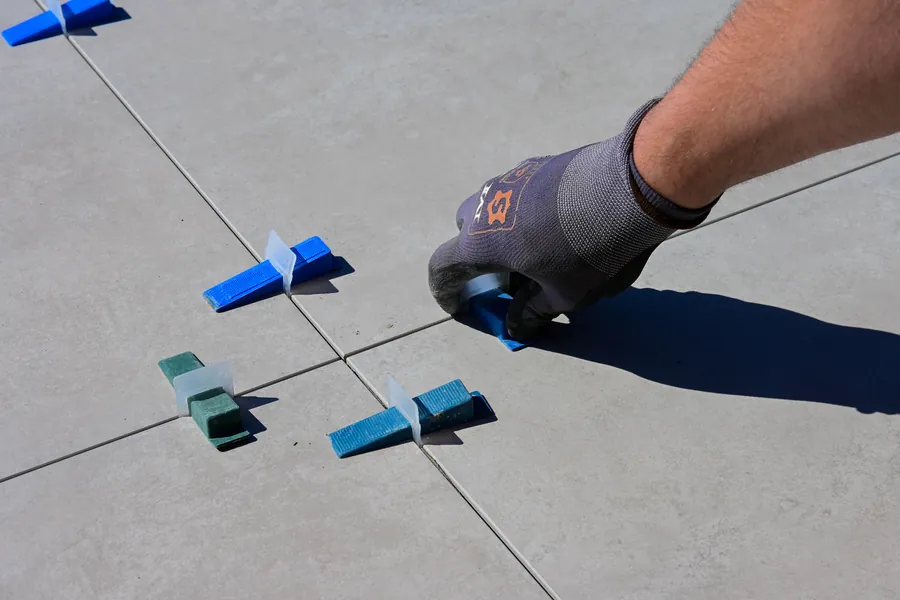
Gloved hand fitting levelling clips between large-format porcelain paving slabs
Design and finish

Sizes, patterns and steps for a sloping Collier Row plot

Where the garden rises away from the house, the terrace usually needs a step up to the lawn or a low wall holding the soil back. We build both in matching slab or brick so it reads as one job. Bigger slabs suit a wide garden and look calm; a mixed-size pattern hides the odd cut better on a narrower one. Edges can be a soldier course, a brick upstand or straight onto a planted bed.

  • 600 x 600 or 900 x 600 slabs to suit the width
  • Mixed-size or straight-laid patterns
  • Steps up to the lawn in matching slab
  • Low retaining walls where the plot slopes

"Most of the Collier Row gardens we survey for a patio have an old concrete strip by the back door that has dropped towards the lawn, and nearly all of it ends up in the skip."

Based on enquiries and jobs handled by Hornchurch & Upminster Driveways.

Cost in Collier Row

What a patio in Collier Row costs

Patios here run at £90 to £150 per square metre laid, and that figure covers the dig, base, membrane, bedding and resin pointing. A 25 m² terrace behind a semi usually lands between £2,300 and £3,800, mostly depending on the slab. Bigger gardens of 40 to 60 m², and anything with steps or a retaining wall, cost more. We price those from the visit rather than guess down the phone.

  • +Slab choice: concrete £75 to £95 per m², Indian sandstone about £90 to £120, limestone £100 to £135, porcelain £110 to £150.
  • +Slope. Gardens rising towards Havering Park and off Lower Bedfords Road can need a step or low wall, which adds a day or two.
  • +Clay. On the London Clay behind Collier Row Lane and Clockhouse Lane, any soft patches under old lawns get dug out deeper and filled with extra stone before the Type 1 goes down.
  • +Breaking out old concrete paths and crazy paving, and the skip to take it all away.
  • +Drainage, where a long channel run or a soakaway is needed because the water cannot go to a border.
Full cost guide →

Guide price from

£90/m²

Collier Row prices are fixed in writing after a free site visit.

Get A Fixed Quote
Out and about

What to do in Collier Row

Fresh pointing needs a day before anyone walks on it, so if you would rather be out of the house, these three are close by.

01

Havering Country Park

A hundred and sixty-five acres of woodland and grassland at Havering-atte-Bower, just north of Collier Row, with the second-largest plantation of wellingtonias in the country. Good for dogs and muddy boots.

Learn more about Havering Country Park on Google Maps

02

Bedfords Park

Country park on Broxhill Road with a captive red deer herd, meadows, woodland and an Essex Wildlife Trust visitor centre that looks out over east London. Green Flag since 2007 and a free car park.

Learn more about Bedfords Park on Google Maps

03

Lawns Park

The local park for the estate itself, close to the shops, with open grass and room for a kickabout. Not a day out, but the right distance for a walk while a resin drive cures.

Learn more about Lawns Park on Google Maps
Where we work

Covering every part of Collier Row

We cover Collier Row from Chase Cross down to Mawneys and across to Havering Park. If you are on the estate or just off it, we will come and measure.

FAQ

Patios questions from Collier Row

Does Havering Council need to approve a patio at the back of my Collier Row house?

Not usually. A patio in the rear garden of a house is normally permitted development, so there is nothing to submit to Havering Council. The exceptions are a listed building, a flat or maisonette, and raising the ground level significantly close to a boundary, which can come up on the sloping gardens towards Havering Park. A patio at the front is different: since 1 October 2008, more than 5 m² of new hard surface there needs permission unless it is permeable or drains to a lawn, border or soakaway on your property.

What does the clay under Collier Row do to a patio?

It moves. London Clay swells when it is wet and shrinks when it dries out, and a terrace laid straight onto it rides up and down with the seasons until slabs crack or rock. We stop that with a geotextile membrane on the clay and 100 to 150 mm of compacted MOT Type 1 on top, laid in two layers. Near big trees we dig further and deeper, because roots dry the ground out unevenly in a hot summer.

How long will my Collier Row garden be out of action?

For a 25 m² terrace with no walls or steps, three to four working days. Add a day or two for steps, a retaining wall on a sloping plot or a long run of drainage. You can walk on the slabs the day after pointing, but keep tables and chairs off for two to three days while the resin joints harden. We normally get in down the side passage, so the house stays usable the whole time.

Porcelain or Indian sandstone: which would you put down?

Depends where the terrace sits. In a shaded corner under trees, porcelain, because it barely takes in water and does not go green the way sandstone does. In full sun, where you want an older and softer look, calibrated Indian sandstone is cheaper and sits well against interwar brick. We would not lay pale sandstone under a sycamore. It will be stained by the second autumn and you will be out with the pressure washer every spring.

Could the new slabs just go on top of the old concrete path?

We would rather not, and on this ground we usually say no. The old concrete behind most of these houses has already cracked or tilted with the clay, and anything stuck to it follows the same cracks. Going over the top also raises the level, which can push the patio up towards the damp course. Breaking it out costs a little more, but you end up with a base you know the depth of.

Do I need a drain along the back of the house?

Sometimes. If the terrace can fall towards a lawn or a planted border, rain soaks away there and no drain is needed. Where the garden falls back towards the house, or the slabs run the whole width, we fit a channel drain along the edge and take it to a soakaway or an existing gully. On clay a soakaway has to be sized generously because the ground accepts water slowly. We tell you on the visit which one applies.

Reviews

What customers around Collier Row say

We would rather show you a driveway than a star rating.

Customer reviews are being collected and will appear here as they come in. In the meantime, when we come out to quote in Collier Row, ask to see photos of recent jobs on houses like yours - and ask the other firms quoting the same question. A finished drive two streets away tells you more than a testimonial ever will.

Get a Collier Row patio priced properly

Call 01708 209015 or use the form. We will come up from Upminster, take the levels, look at the clay and give you a written price with the base spelled out.