Upminster, RM14

Patios In Harold Wood

Is the back garden in Harold Wood ready for a proper patio?

Slab terraces laid on a compacted stone base, from the railway roads to Kings Park

Harold Wood has two very different kinds of back garden, and a good patio starts by knowing which one you have. Near the station, on Athelstan Road, Alfred Road and Queens Park Road, the Victorian terraces have narrow plots and often no side gate at all, so every bag of stone has to come through the house or along a shared alley. Up at Kings Park on the old hospital site, the gardens are only a few years old and usually sit on builder's topsoil over whatever was left behind. We lay patios in Harold Wood for both, plus the interwar semis on Squirrels Heath Road and Harold Court Road in between, and every one goes down on a dug-out, compacted base over the clay rather than on a scrape of sand.

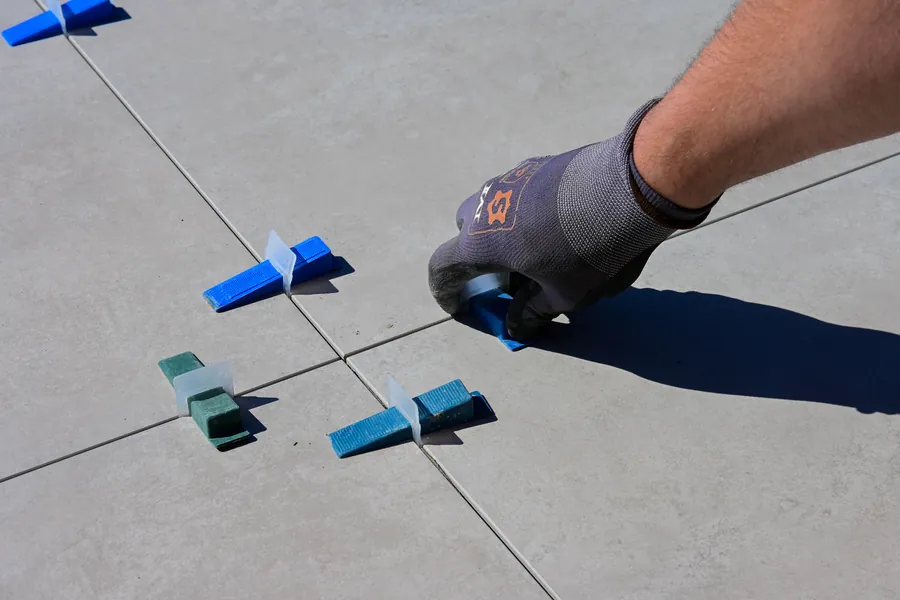
Gloved hand fitting levelling clips between large-format porcelain paving slabs
No obligation

Free Patios Quote In Harold Wood

We reply the same working day, usually within the hour.

Or ring 01708 209015. Your details stay with us.

The family behind the firm

Harold Wood patios, laid by a family firm

Harold Wood is a few miles up the Ingrebourne from our Upminster base, which keeps it well within reach. Jim and his family have specialised in patios and driveways for 35 years, and the clay gardens on the rise towards Harold Court call for that experience.

We get most of our work by recommendation and keep the business deliberately small. Less travel means lower overheads, and that is why the price for a properly bedded patio stays lean.

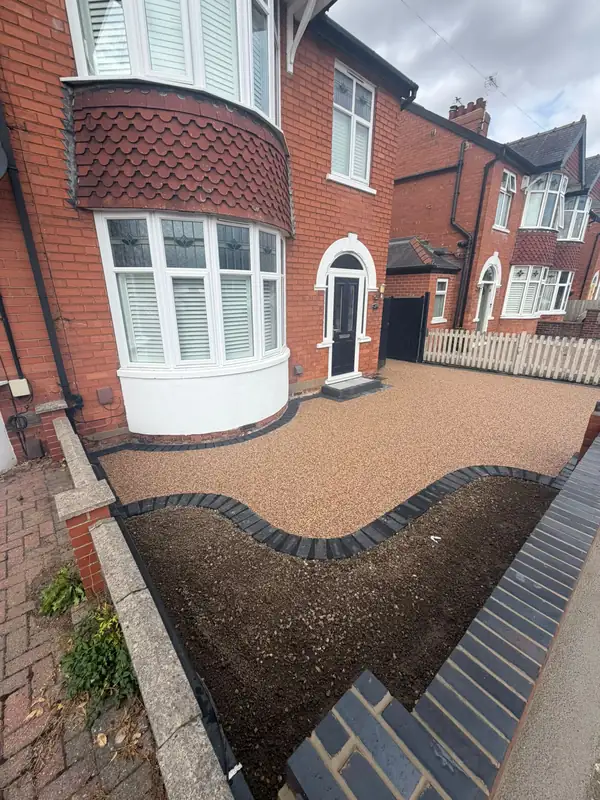
Buff resin bound front garden with curved dark block edging around a new soil bed outside a red brick bay-fronted house
Buff resin front with curved block edging
Patios in Harold Wood

What a well-built patio gets a Harold Wood household

01

Somewhere dry to step out to

Clay lawns around Harold Wood turn soft from about October to March. A laid terrace by the back door means you can still get to the bins, the shed and the washing line without carrying half the garden into the kitchen.

02

Water sent the right way

We set a fall of at least 1 in 80 away from the house and plan where the run-off ends up. On ground this close to the Ingrebourne, that matters more than the slab you pick.

03

A fix for tired new-build paving

Some newer gardens came with a small strip of thin grey slabs on sand. We lift it, dig properly and build a terrace big enough to put a table on, sized to the garden rather than the minimum.

04

Less mowing in a narrow plot

A railway-road terrace garden might only be a few metres wide. Paving the first third of it gives you a usable seating area and leaves a lawn small enough to cut in ten minutes.

05

Joints that keep weeds out

We point with a two-part resin jointing compound, which sets hard and does not wash out the way a weak sand and cement mix does after a couple of winters.

06

Steps and edges done in one go

If your garden rises away from the house, as plenty do on the slope up towards Harold Court, we can build the steps and a low retaining wall at the same time as the terrace.

Local

Upminster Based

Hornchurch, Upminster and across Havering

6

Surface Types

Resin to gravel, one crew for all of it

Free

Site Visits & Quotes

Written, itemised and fixed

Written

Guarantee

Handed over on paper at the final walk-round

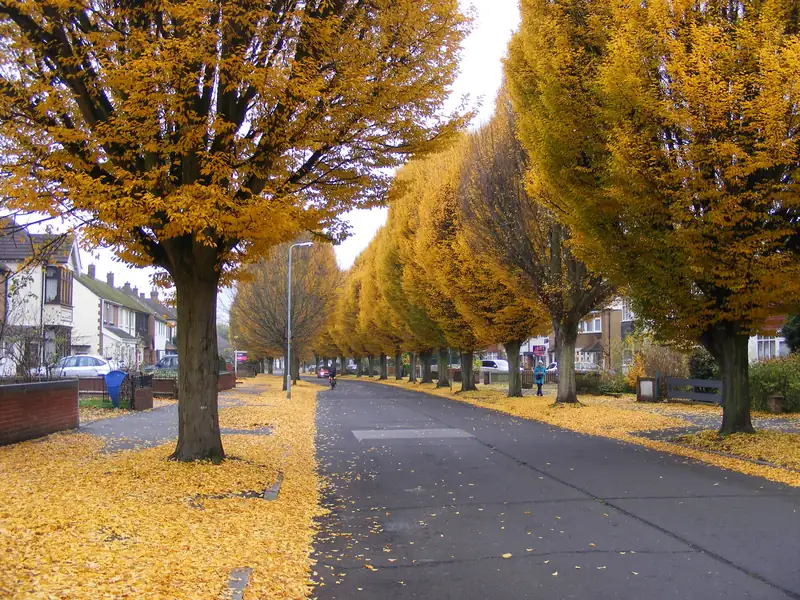
Autumn street of brick houses lined with trees and parked cars
About Harold Wood

Patios on Harold Wood clay, from railway terraces to the hospital site

Most of Harold Wood sits on London Clay, and the clay here climbs gently east towards Harold Court and the M25. That clay swells when it is wet and shrinks in a dry August, which is why a slab laid straight on a few centimetres of sand ends up rocking within a year or two. We dig out, lay a geotextile on the soft clay, then build 100 to 150 mm of MOT Type 1 in two compacted layers. On a terrace off Station Road, with everything barrowed through, that is slow and dusty, and we tell you so before we start.

Kings Park is a different job. Countryside finished the estate in 2023, and new-build back gardens tend to hide compacted spoil, odd bits of rubble and the odd drainage pipe under a thin layer of turf. We dig a test hole before quoting so the price reflects what is actually down there. If the front of the house has started to dip by the garage as well, which we see on newer estates, it makes sense to look at fixing a settled Harold Wood driveway on the same visit and plan the two jobs together.

Planning authority: Havering Council

How it works

How we lay a patio in Harold Wood

Seven stages, most of them under the slabs where you will never see them again. Here is what happens on a typical Harold Wood garden.

  1. Garden visit and levels

    We come out, measure, check the height of your damp-proof course and dig a small test hole so we know whether we are into clay, made ground or the odd pocket of gravel.

  2. Layout and written price

    You get a drawing of the terrace size and shape, the slab you have chosen and a fixed figure that lists the base depth, so there is nothing vague left to argue about later.

  3. Digging out

    We excavate to the depth on the quote. On a station-side terrace with no side gate that means hand digging and barrowing through, with dust sheets down along the hallway.

  4. Building the base

    Geotextile goes over the clay, then MOT Type 1 is laid and compacted in two passes with a plate compactor until it stops moving underfoot.

  5. Edges and drainage

    We set the fall away from the house and fix a restraint along any open edge. Where run-off has nowhere to go, we add a channel or a gravel strip by the lawn.

  6. Laying the slabs

    Each slab is bedded on a full mortar bed, primed on the back if it is porcelain, and checked for level and fall as we go rather than at the end.

  7. Pointing and handover

    Resin jointing goes in, the surface is cleaned off and we walk the terrace with you. You can walk on it the next day; furniture waits two or three days.

  8. Not sure which surface suits the house? The cost guide compares all six side by side, and the site visit is free either way.

The guarantee

What our guarantee actually covers on a Harold Wood driveway

Most guarantees in this trade cover the surface, because the surface is the easy bit. Ours is written around the structure underneath, which is where a driveway on Havering's London clay either holds or does not. We put the excavation depth, the compacted MOT Type 1 thickness, the concrete haunch behind every edge and the drainage route on the quote, and we guarantee that build. If the surface sinks, spreads or ponds because any of that was not done right, we come back and fix it at our cost.

  • Sub-base depth and compaction written on the quote, not left to the day
  • Every edge course set on concrete and haunched, so nothing creeps
  • Settlement, rutting or lifting caused by our groundwork put right free
  • Manufacturer cover on resin, block and porcelain on top of ours

In

Writing, before we start

The guarantee terms go on the quote, not on a leaflet after the job

0

Overlays on a bad base

We will not lay a new surface over a base that has already failed, however cheap it would make the quote

Before you choose anyone

What to look for in a patio installer around Harold Wood

Ask how deep they intend to dig. If the answer is vague, or the quote never mentions a base at all, you are probably looking at slabs on sand. On Harold Wood clay that usually means a wobbly terrace and puddles against the back wall by the second winter. A firm that has thought about your garden will give you a number in millimetres and will happily write it on the quote.

Watch what they do on the visit. Someone who glances at the garden from the patio doors and emails a price per square metre has not checked the levels against your damp-proof course. The finished patio must sit at least 150 mm below it, and on older Victorian houses near the station the DPC can be surprisingly low, which changes how far down the dig has to start.

Find out how they handle access before the day. A Harold Wood terrace without a side gate means tonnes of spoil going out through your hallway and new stone coming back in. Ask about dust sheets, skip placement on the road and how many days that adds. A sensible installer builds the barrowing time into the price instead of discovering it on the morning and charging extra.
Compared

Choosing slabs for a Harold Wood garden

We lay four kinds of slab. They all work on a properly built base, but they wear, mark and cost differently, and some sit better with one style of house than another.

Option PorcelainIndian sandstoneLimestoneConcrete slabs
Price laid per m² £110 to £150£90 to £120£100 to £135£75 to £95
How much water it soaks up Next to noneSome, so it darkens when wetA little, depending on finishA fair amount
Green growth under the trees Wipes off easilyShows up in shady cornersShows less than sandstoneGrows in quickly
Spilt wine or barbecue fat Rarely leaves a markCan mark if leftNeeds wiping quicklyMarks fairly easily
Looks right with Kings Park and other recent buildsVictorian brick near the stationInterwar semis with render or pebbledashA practical strip by the shed
Upkeep through the year A hose and a brushA wash each spring, seal if you likeAn occasional cleanJet wash every year or two
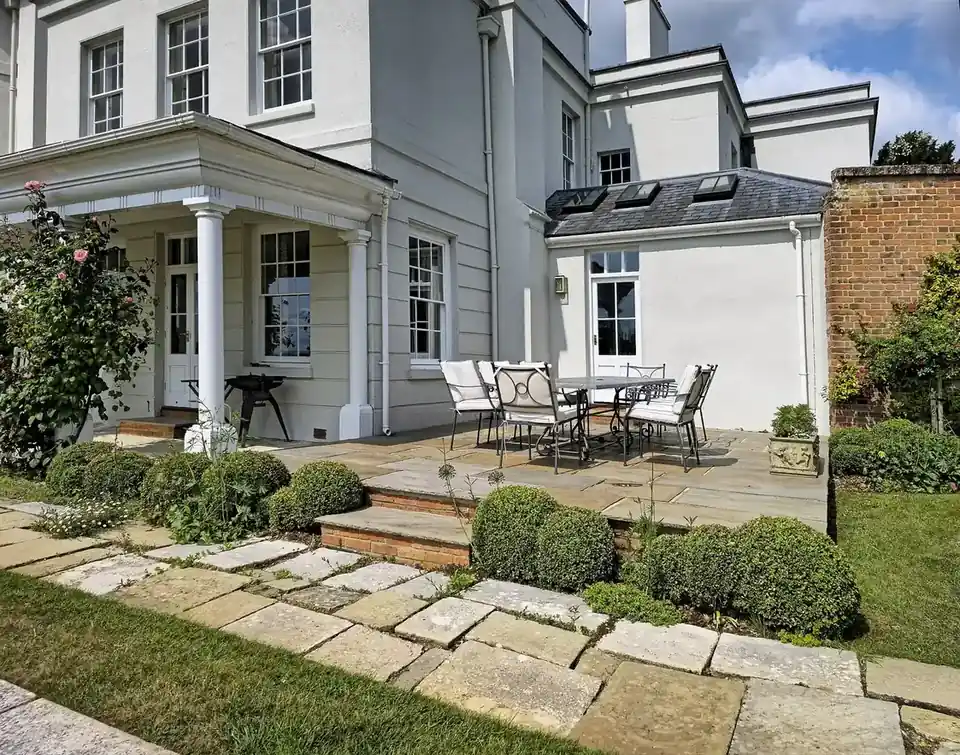
Natural stone patio with a rattan dining set outside the French doors of a brick house, with clipped shrubs in pots
Design and finish

Slab sizes, patterns and level changes

A narrow terrace garden near the station looks bigger with larger slabs laid in a straight run along its length. A wider semi garden can take a random pattern of mixed sizes. If your lawn sits higher than the back door, as it often does on the gentle slope up towards Harold Court, we build steps and a low wall so you do not end up with a terrace that floods against the brickwork.

  • 600 x 600 or 900 x 600 slabs for narrow plots
  • Mixed-size random pattern in sandstone or limestone
  • Block steps up to a raised lawn
  • Low brick or sleeper retaining wall along the edge

"On the Kings Park new-builds, what looks like garden is often a thin skin of topsoil over builder's fill, and that decides how deep we dig before a single slab goes down."

Based on enquiries and jobs handled by Hornchurch & Upminster Driveways.

Cost in Harold Wood

What a patio costs in Harold Wood

Laid patios run from £90 to £150 per square metre depending on the slab, with excavation, base, bedding and pointing all included. Put a standard 25 m² terrace behind a Harold Wood semi and you are usually looking at £2,300 to £3,800. Bigger gardens of 40 to 60 m², or anything with steps and walls, cost more, and we price those on the visit. Here is what pushes a Harold Wood figure up or down.

  • +Access: a station-side terrace on Athelstan Road or Alfred Road with no side gate means barrowing everything through the house, which adds labour.
  • +Ground: the London Clay rising towards Harold Court and Squirrels Heath Road needs a geotextile and the full two-layer Type 1 base, never a shallow scrape.
  • +Fill on new-build plots: at Kings Park we sometimes hit rubble or old foundations under the turf, and digging that out costs more than clean soil.
  • +Slab choice: concrete from about £75 per m², porcelain up to about £150, with sandstone and limestone in between.
  • +Extras such as steps, low walls or a long drainage run, which add a day or two to the usual three or four.
Full cost guide →

Guide price from

£90/m²

Harold Wood prices are fixed in writing after a free site visit.

Get A Fixed Quote
Out and about

What to do in Harold Wood

The mortar needs the morning to itself, so on the last day of your Harold Wood patio it is a good time to get the family out to one of these.

01

Harold Wood Park

Open grassland between Squirrels Heath Road and the Ingrebourne, with tennis courts, football pitches and a footbridge over the river to the east side. Big enough for a proper run with the dog.

Learn more about Harold Wood Park on Google Maps

02

Pages Wood

A 74-hectare Forestry England wood on the far bank of the Ingrebourne from Harold Wood Park, planted with 100,000 trees since 2002. Six and a half kilometres of footpath and a bridleway loop.

Learn more about Pages Wood on Google Maps

03

Dagnam Park

Woods, ponds and the remains of a mansion garden on the Harold Hill side, with deer in the quieter corners. Known locally as The Manor, and just up the road from Harold Wood.

Learn more about Dagnam Park on Google Maps
Where we work

Covering every part of Harold Wood

We come up from Corbets Tey Road in Upminster to every corner of Harold Wood, from the terraces by the station to Harold Park and the Kings Park estate.

FAQ

Patios questions from Harold Wood

Will Havering Council need a planning application for a patio at the back of my Harold Wood house?

Almost certainly not. A patio in a rear garden is normally permitted development, so Havering Council does not need an application. The exceptions are a listed building, a flat or maisonette, and any job that raises the ground level a long way near a boundary, which can cross into needing permission. Harold Wood has no conservation area covering back gardens. If you are paving a front garden instead, the 2008 rule applies: over 5 m² must be permeable or drain into a border or soakaway on your own land.

My Harold Wood garden turns to mud every winter. Will a patio cope?

It will if the base is right. The clay under most of Harold Wood holds water for months, and close to Harold Wood Park the Ingrebourne valley is lower and wetter still. We dig out, lay a geotextile so the stone does not sink into the clay, and build 100 to 150 mm of compacted Type 1. The surface falls away from the house at 1 in 80 or more. Where the lawn already sits waterlogged, we add a gravel strip or channel so the run-off has somewhere to go.

Do you lay patios in Harold Wood on the Victorian roads by the station?

Yes, and those are some of the fiddliest gardens we price. Many houses on Athelstan Road, Alfred Road and Queens Park Road have no side access, so the spoil comes out through the house and the stone goes back the same way. We lay heavy dust sheets, use smaller skips and allow the extra labour in the quote rather than adding it on the day. The gardens are narrow, so large-format slabs usually look better than small ones.

Is porcelain worth the extra over sandstone?

It depends on the garden. Porcelain barely absorbs water, so green growth and stains wipe off, and it suits the brick and clean lines of a newer house like those at Kings Park. Indian sandstone costs less, from about £90 per m², and has more variation in colour, which tends to sit well against older brick. Under trees, sandstone greens up faster. We use 20 mm porcelain and 22 mm calibrated sandstone, both on a full mortar bed.

How long will my garden be out of action?

A 25 m² terrace with no steps or walls takes three to four working days. Steps, walls or a long drainage run add another day or two. You can walk on it the day after pointing, but keep the table and chairs off for two or three days while the joints harden fully. If we are barrowing through the house on a terrace with no side gate, allow a bit longer at the dig stage.

Can you lift the old slabs and reuse them?

Sometimes, if they are sound and you like them. Old concrete slabs often crack when they come up, so we would not promise more than a handful of usable ones. Natural stone usually lifts better. Even when the slabs are kept, the base under them nearly always has to be dug out and rebuilt, because that is what failed in the first place.

Reviews

What customers around Harold Wood say

We would rather show you a driveway than a star rating.

Customer reviews are being collected and will appear here as they come in. In the meantime, when we come out to quote in Harold Wood, ask to see photos of recent jobs on houses like yours - and ask the other firms quoting the same question. A finished drive two streets away tells you more than a testimonial ever will.

Get a Harold Wood patio priced properly

We will come out, dig a test hole and give you a written figure that states the base depth. Ring 01708 209015 to book.